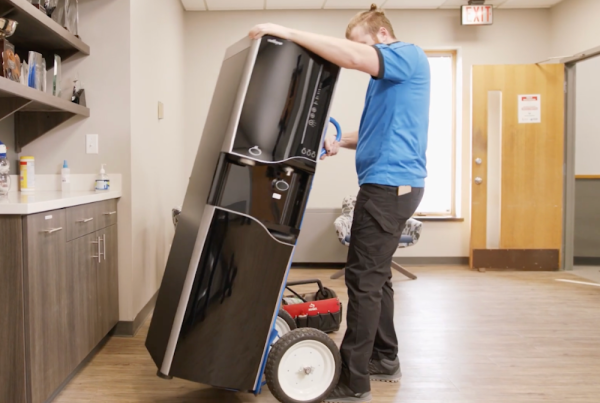

You’ve probably walked past your office water cooler a hundred times without giving it a second thought. But here’s a question worth asking: when was the last time anyone checked what’s in it?
Most of us don’t question the drinking water in our workplaces. But when you start looking at where the water comes from, who handles it, what’s growing inside the equipment, and what it’s really costing, the picture gets a lot more complicated. 
Turns out, the humble office water cooler comes with more hidden risks than most people realize. From germs to physical injury to surprise costs, there’s a lot going on behind the scenes that rarely gets talked about. In this blog, we’ll look at five of the biggest risks hiding in plain sight, and what you can do about them.
Want the full picture? We recently hosted a webinar, 5 Hidden Risks of Traditional Office Water Coolers, with Rob Batcho, Sales Manager at Pure Water WNY, who works with organizations on exactly this every day. Watch the full webinar here for a much deeper dive, including real-world stories from the field that will make you look at your office cooler very differently.
1. Contamination You Can’t See
Water coolers consistently rank among the top five germiest items in any office, and a lot of it comes down to something most people have never even heard of: biofilm.
A biofilm is a bacterial layer that forms on the inside of water-cooler systems over time. Think of that slippery, slimy film you sometimes notice on a pet’s water bowl; that’s essentially what can build up inside your office cooler’s internal components, tubing, and spigot housing. What makes biofilm particularly problematic is that it creates a protective shield that allows bacteria to live and regrow, even after the cooler appears to have been cleaned.
A study of bottled water cooler dispensers found that over 60% exceeded acceptable safe limits for microorganisms. And a comprehensive review of roughly 70 studies, covered by WUSF Public Radio in early 2026, found that office water dispensers often show higher levels of bacterial contamination than the water feeding them, which is a pretty striking finding given that most people switch to a cooler, thinking it’s the cleaner option.

The International Bottled Water Association recommends cleaning a five-gallon jug cooler every six weeks. That cleaning isn’t a quick wipe-down; it’s a 12-step process that takes roughly 45 minutes per unit and involves dismantling the cooler, draining the spigots, scrubbing internal components, and disinfecting the entire unit. Most offices aren’t doing this. Many don’t even know they’re supposed to.
In our webinar, Rob shared real photos from offices he’s visited that show exactly what builds up inside these units over time; worth a look if you want the full picture.
2. A Lifting Hazard That’s Hiding in the Break Room
Here’s a workplace safety risk that almost never shows up in a risk assessment: the water jug.
A standard five-gallon jug weighs between 42 and 50 pounds. To put that in perspective, that’s roughly equivalent to a full carry-on suitcase, a car tire, or five gallons of paint from the hardware store. And someone, usually whoever happens to be standing nearby when the cooler runs dry, is expected to hoist that jug above chest height and flip it upside down onto the cooler, often with no training, no equipment, and no real awareness of the risk they’re taking on.
Slips, falls, and physical strain consistently rank among the top five workplace injuries across industries. Spilled water on a hard floor creates an instant slip hazard. And the awkward overhead motion of flipping a 45-pound jug is exactly the kind of movement that leads to back injuries and shoulder strain.
Rob put it plainly in the webinar: “I’ve never seen a prospect or customer that has one of those pulley devices. They’re doing it by hand, and you’re opening yourself up to potential lawsuits, spill risks, and workers’ comp claims.”
There’s also another version of this problem that’s easy to overlook. Because nobody wants to be the person who changes the jug, it often just doesn’t get changed. Rob described walking into a prospect’s lobby and finding an empty cooler because no one had volunteered to deal with it. When the barrier to hydration is a 45-pound jug and an awkward lift, people drink less water, which has its own downstream effects on focus and productivity.

3. An Unknown Chain of Custody
When a five-gallon jug arrives at your office, do you know where it’s been?
Those jugs are typically reused up to 50 times before being retired. Between uses, they’re handled by multiple people, loaded in and out of delivery trucks, potentially exposed to sunlight and temperature swings, and stored in conditions that vary widely depending on the provider. The jug sitting on your cooler right now may have been in dozens of other offices before yours.
As WUSF reported in early 2026, bacterial biofilms can regrow within days even after a cooler has been properly cleaned and treated. That means even if a jug left the facility in good condition, what happens between there and your break room matters, and it’s largely out of your hands.
This isn’t just a hygiene concern. It’s also a water quality concern. Municipal tap water is treated with chlorine specifically to suppress bacterial growth. Five-gallon jug water typically doesn’t contain chlorine, which sounds like a good thing, and in some ways it is, but it also means there’s no residual protection against bacterial growth once the water sits in the cooler. The longer it sits, the more opportunity there is for something to take hold.
For most healthy adults, low-level bacterial exposure from a water cooler isn’t going to cause a dramatic health event. But for employees who are immunocompromised, pregnant, elderly, or managing chronic illness, contaminated workplace water can represent a genuine risk, particularly in healthcare or senior care environments.
4. Microplastics and the Shared Spigot
Two of the less-talked-about risks with traditional office coolers are microplastics and cross-contamination.
On the microplastics front, a 2018 peer-reviewed study published in Frontiers in Chemistry tested 259 bottles from 11 brands across nine countries and found that 93% contained microplastics. The finding was significant enough that the World Health Organization launched its own review into plastic particles in drinking water. Five-gallon jugs, especially heavily reused ones, aren’t immune to this. Surface wear, UV exposure, temperature changes, and repeated handling can all contribute to plastic leaching into the water supply.

Then there’s the shared spigot. According to a 2026 report by WUSF Public Radio, which reviewed roughly 70 international studies, dispenser nozzles were found to be 100 times more contaminated than other parts of the machine, and they’re the exact surfaces people press their cups and bottles against every day. It’s worth keeping in mind that these are shared touchpoints that typically don’t make it onto anyone’s cleaning schedule.
The webinar includes a story about cross-contamination that’s worth hearing firsthand. Check out the webinar recording to find out more.
5. Costs That Are Harder to Track Than You Think
The costs associated with five-gallon jug systems aren’t always obvious because they’re spread across multiple line items: the per-jug cost itself, delivery fees, cooler rental charges, and jug deposits. The per-jug price can also change with little notice; there are accounts where the price has effectively doubled without the customer realizing it until they happen to look closely at an invoice.
There’s also the invisible cost of variability. Water consumption goes up in the summer. It goes up when you hire more staff. When you run out mid-week and nobody reordered in time, productivity takes a quiet hit. Budgeting for bottled water is harder than it looks.
What’s the Alternative?
Bottleless water coolers, also called point-of-use coolers, connect directly to your building’s water line and filter water on demand. No jugs to lift. No chain of custody to worry about. No running out mid-afternoon because nobody remembered to reorder.
Modern systems use multi-stage filtration, including reverse osmosis and remineralization, which strips water down to its purest form and then adds beneficial minerals back in, calcium, magnesium, and electrolytes, to balance pH and improve taste. Many systems are certified to reduce microplastics. And because the internal components are typically stainless steel rather than plastic, they’re less hospitable to the kind of biofilm growth that plagues traditional jug coolers.
Maintenance is handled by the provider, not by whoever happens to be in the office that day. At Pure Water WNY, that includes an annual nine-stage diagnostic test, filter changes, and responsive service if anything comes up in between.
They also offer a free seven-day trial, no paperwork, no commitment. They install the unit, you try it out, your whole team tries it out, and at the end of the week, you decide if it makes sense. If it doesn’t, they come pick it up.
The Bottom Line
Office drinking water is one of those things that feels like a non-issue right up until it isn’t. A contamination event, a workers’ comp claim from a jug-related injury, or a billing audit that surfaces years of unchecked spending, any of these can trace back to a cooler that nobody was really paying attention to.
We covered all of this, and then some, in our recent webinar with Rob Batcho. There’s a lot more detail, a lot more context, and a few stories that really drive the point home. Watch the full webinar 5 Hidden Risks of Traditional Office Water Coolers here.
Or if you’re ready to have a conversation, book a discovery call with the Pure Water WNY team at purewaterwny.com.
About Us
Pure Water of Western and Central New York has proudly served over 1,000 customers with high-quality water and ice purification systems since 2008. As a locally owned, family-run business, we take pride in building lasting relationships with the communities we serve. Our commitment to clean, great-tasting water and outstanding service has earned us national recognition, including multiple awards from Wellsys for top-tier performance. As a certified MWBE (Minority and Women Owned Business Enterprise) and a supporter of Cradle Beach—an organization dedicated to providing memorable experiences for children with disabilities and special needs—we’re passionate about promoting inclusion, giving back to our community, and delivering environmentally responsible solutions that make a difference every day.