

Clean, safe water is more than a convenience in business settings; it affects health, operational performance, and even customer perception. Whether you run a restaurant, a dental clinic, a manufacturing facility, or an office, the water you use matters. Many businesses install water treatment systems to improve taste and protect equipment, but not all systems deliver the same level of purification.
Two of the most common options are single filter systems and reverse osmosis (RO) systems. Single filters are affordable and easy to install, but are they enough? Reverse osmosis systems provide deeper purification, but at a higher cost and with more complex maintenance.
In this blog, we’ll break down how these systems work, what contaminants they remove, and, most importantly, how to decide which is best for your business.

What Is a Single Filter System?
A single filter system (often carbon-based) typically combines sediment filtration with activated carbon. These systems are found in many offices, breakrooms, or entry-level commercial applications because they are compact, affordable, and effective at improving basic water quality.
How It Works
- Sediment filter catches visible particles like sand and rust.
- Activated carbon adsorbs chemicals that affect taste, odor, and certain impurities.
- These filters are usually point-of-use and easy to replace.
What It Removes
Single filters excel at removing:
- Chlorine and chloramine (taste and odor)
- Sediment and particulates
- Some volatile organic compounds (VOCs)
However, they do not reduce most dissolved salts or minerals and are limited in their ability to remove serious contaminants. Carbon filtration works through adsorption, where contaminants stick to the surface of the carbon media as water flows through.
Use Case Snapshot:
A café concerned about chlorine taste is a perfect candidate for a carbon filter under the sink. It delivers pleasant-tasting water with minimal investment.
What Is Reverse Osmosis (RO)?
Reverse osmosis is a more advanced water purification process that goes well beyond what standard filters can do.
How Reverse Osmosis Works
Reverse osmosis pushes water through a semipermeable membrane under pressure. The membrane’s microscopic pores allow water molecules to pass while blocking most other substances. RO systems often include pre-filters (sediment and carbon) to protect the membrane and post-filters to polish the purified water.
Contaminant Removal Power
Here’s where RO shines:
RO systems can remove up to 99% of total dissolved solids (TDS), including heavy metals, nitrates, pesticides, microbes, and more.
This level of reduction goes far beyond taste and smell, it significantly lowers contaminants that can affect health, performance, and equipment life.
Why Certification Matters
Many high-quality RO systems are tested under NSF/ANSI Standard 58, which is specifically designed to evaluate reverse osmosis systems for contaminant reduction performance. That means claims about what the system removes are independently verified.
Use Case Snapshot:
A dental clinic using RO-treated water for equipment flushing helps protect sensitive instruments and supports infection control.
Reverse Osmosis vs. Single Filter: Side-by-Side
To understand which solution fits your business, it helps to compare what these systems actually remove.
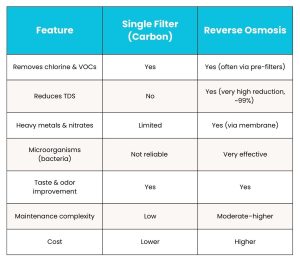 Single Filter Strengths
Single filters are ideal for:
- Improving taste and scent
- Reducing chlorine and certain organic chemicals
- High flow rates with minimal installation
If the main concern is simply chlorine taste from municipally treated water, a single filter can be perfectly adequate.
Reverse Osmosis Strengths
RO systems are ideal for:
- Water with high levels of dissolved solids (TDS)
- Sensitive operations that depend on high-purity water
- Removing a broad spectrum of contaminants not handled by carbon filters
Because RO removes dissolved solids like minerals and salts, it’s especially useful in industries where scaling from mineral deposits can damage equipment.
Why This Matters for Your Business
Here are the real-world implications of each option:
Health & Safety Compliance
In regulated sectors like healthcare, manufacturing, or food service, water purity standards can be strict, and failures costly. Reverse osmosis delivers water that meets higher levels of purification, helping businesses stay compliant.
Equipment Protection & Longevity
High dissolved solids cause scale buildup in boilers, coffee machines, dishwashers, and steam equipment. RO-treated water helps reduce scaling and corrosive deposits, lowering repair costs and extending equipment lifespan.
Even if your city water is “treated,” levels of minerals and dissolved solids can vary dramatically by region, making the deeper purification of RO worth the investment.
Customer Experience
Nothing signals quality like clean-tasting water. In client-facing areas, from hotel lobbies to cafés to healthcare waiting rooms, providing high-quality water can positively influence perception.

Cost & Maintenance Considerations
Choosing the right system is not just about performance; it’s about total cost and ease of upkeep.
Single Filter Systems
Pros:
- Affordable initial cost
- Fast installation
- Low maintenance
- No wastewater production
Cons:
- Limited contaminant removal
- Frequent cartridge changes if the water quality fluctuates
- Best for businesses that primarily need taste and odor improvement rather than deep purification.
Reverse Osmosis Systems
Pros:
- Broad contaminant removal
- Independent certification (NSF/ANSI 58) validates performance
- Can significantly extend equipment lifespan
Cons:
- Higher upfront cost
- More complex installation
- May require wastewater management
- Membrane and filter replacement are needed over time
For businesses that rely on consistent purity, like laboratories, restaurants, and medical practices, the investment often pays off.
Practical Decision Checklist
Before choosing a solution, ask:
- What’s in your water? Test your water quality first.
- Do you need TDS reduction? If yes, RO is likely the better choice.
- Is taste improvement your priority? Single filters may suffice.
- What’s your water usage volume? Higher volumes may favor systems designed for capacity and purity.
- What are your compliance needs? Industries with strict standards may benefit from RO.
This checklist helps businesses avoid under- or over-spending on a system that doesn’t align with actual requirements.
Bottom Line
There’s no single answer for every business, but understanding the differences provides clarity:
- Single filters are efficient at improving taste and reducing chlorine and certain VOCs. They are cost-effective and easy to install, ideal for basic water quality improvements.
- Reverse osmosis systems deliver deeper, more comprehensive purification. They reduce total dissolved solids and a wider range of contaminants. When water purity affects health, compliance, or equipment life, RO is often the better choice.
Ultimately, start with a professional water test. Knowing what’s in your water guides you to the right technology, not just the most popular one. Whether it’s a simple filter upgrade or a full RO system, matching the solution to your business needs ensures healthier water, smoother operations, and better outcomes.
About Us
Pure Water of Western and Central New York has proudly served over 1,000 customers with high-quality water and ice purification systems since 2008. As a locally owned, family-run business, we take pride in building lasting relationships with the communities we serve. Our commitment to clean, great-tasting water and outstanding service has earned us national recognition, including multiple awards from Wellsys for top-tier performance. As a certified MWBE (Minority and Women Owned Business Enterprise) and a supporter of Cradle Beach—an organization dedicated to providing memorable experiences for children with disabilities and special needs—we’re passionate about promoting inclusion, giving back to our community, and delivering environmentally responsible solutions that make a difference every day.