
The water supplied to your office is treated before it reaches your building, traveling through water mains and service lines along the way. Once inside, it moves through your building’s plumbing before reaching your faucet or water dispenser.
Some workplaces choose to treat their drinking water further at the point of use. Reverse osmosis, commonly called RO, is one way to do that.

Reverse osmosis uses pressure and a specialized membrane to separate water from many dissolved substances. But the RO membrane is only one part of a typical treatment system. Sediment and carbon filters are often used before the membrane, and additional treatment can take place afterward.
Understanding these different stages makes it easier to see what reverse osmosis does and how more advanced office water systems build on the process.
Key Takeaways
- Reverse osmosis uses pressure to force water through a semipermeable membrane that rejects many dissolved substances.
- RO is different from natural osmosis, which occurs without applied pressure.
- Sediment and carbon filters are commonly used before an RO membrane to address particles, chlorine, and other substances.
- The RO membrane is one stage within a larger water treatment process, not necessarily the entire process.
- Treatment can continue after reverse osmosis with technologies such as carbon filtration and mineral enhancement.
- Pure Water Western New York offers bottleless systems that combine RO with additional treatment stages, depending on the model.
What Is Reverse Osmosis?
To understand reverse osmosis, it helps to start with regular osmosis.
Osmosis is a natural process in which water moves through a semipermeable membrane toward a solution with a higher concentration of dissolved substances. This movement happens naturally without a pump or other external pressure.
Reverse osmosis changes the direction of that process.
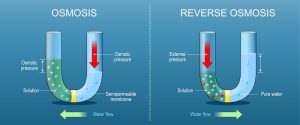
Pressure is applied to the water, forcing it through a semipermeable membrane in the opposite direction. Water passes through the membrane while many dissolved substances are rejected.
This produces two streams. The treated water continues through the system, while a separate reject water stream carries away substances that did not pass through the membrane.
RO differs from conventional filtration in that it can remove many dissolved substances that may pass through other filters. However, an RO membrane is generally not used on its own. Other filtration stages prepare the water before it reaches the membrane and, depending on the system, treat it further afterward.
Here is how those stages typically work.
Step 1: Water Enters the Treatment System
A bottleless water dispenser connects directly to your building’s existing water line. Instead of drawing water from a five-gallon jug, it uses the same water supply that serves the rest of your building.
From the water line, the water enters the dispenser’s filtration system. Before reaching the reverse osmosis membrane, it typically passes through sediment and carbon filters that reduce larger particles, chlorine, and other substances.
Step 2: Sediment Filtration Reduces Larger Particles
The water first passes through a sediment filter, which reduces larger particles such as dirt, silt, and rust that may be present in the water.
This first stage also helps protect the filters and RO membrane that follow by preventing larger particles from reaching them. Once these particles have been filtered out, the water moves to the carbon filter.
Step 3: Carbon Filtration Addresses Chlorine and Other Substances
The carbon filter targets substances that a sediment filter cannot. Activated carbon can reduce chlorine and certain other chemicals that may affect the taste and odor of the water.
This stage can also help protect the RO membrane. Chlorine can damage certain types of RO membranes over time, so reducing it before the water reaches the membrane is an important part of the treatment process.
Carbon filtration and reverse osmosis serve different purposes. Carbon targets substances such as chlorine, while the next RO membrane can reduce many dissolved substances that carbon filtration alone may not remove.
Step 4: Pressure Moves Water Through the RO Membrane
After pre-filtration, the water reaches the reverse osmosis membrane. Pressure pushes water through the membrane, which allows it to pass while reducing the concentration of many dissolved substances, including salts and certain metals.
The water that passes through the membrane continues through the system for further treatment or dispensing. Water containing the substances rejected by the membrane is directed away through a separate drain line.
Reverse osmosis can significantly reduce many dissolved substances, though the extent depends on the membrane and the quality of the incoming water. It can also reduce the presence of naturally occurring minerals. For this reason, some systems include a remineralization stage that adds selected minerals back into the water after RO treatment.
Step 5: The Water Can Receive Additional Treatment
After passing through the RO membrane, the water may go through one or more final treatment stages before it is dispensed.
Because reverse osmosis can reduce naturally occurring minerals, some systems include a remineralization stage that adds selected minerals back into the water. A post-carbon filter may also be used to improve the water’s taste and odor.
The exact process varies by system. Some end with carbon filtration, while others include mineral enhancement or other treatment after RO. This is why reverse osmosis is best understood as one part of the overall water treatment process rather than the final step.
How Pure Water WNY Goes Beyond the RO Membrane
This is where the distinction between reverse osmosis and a complete water purification process becomes important.
Pure Water Western New York offers bottleless water systems that use multiple stages of treatment before water is dispensed. In systems that use reverse osmosis, treatment begins before the water reaches the RO membrane and can continue after it passes through.
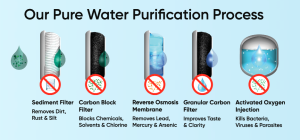
Pre-filtration can include sediment filtration to reduce particles such as dirt, silt, rust, and pipe residue, followed by carbon filtration to reduce chlorine and other substances. The water then passes through the RO membrane, which reduces many dissolved substances.
Treatment can continue after reverse osmosis. Since RO can also reduce naturally occurring minerals, select systems add minerals and electrolytes back into the water after membrane treatment. Final carbon filtration can further polish the water for taste.
This means reverse osmosis is one part of a broader treatment process. The filters before the membrane prepare the incoming water; the RO membrane removes many dissolved substances; and post-treatment can enhance the water before it is dispensed.
That is also an important difference between multi-stage purification and basic filtration. A water cooler that relies on a single carbon filter treats water differently from a system that combines sediment filtration, carbon filtration, reverse osmosis, and post-treatment.
Filtration configurations vary by system, but understanding the full treatment process provides a clearer picture of what happens to the water in your office before it reaches your cup.
Cleaner Water, Right at the Point of Use
For offices, a bottleless system brings multi-stage water treatment directly to the point of use. Water is treated as it enters the dispenser, giving employees and visitors access to purified drinking water without relying on five-gallon water jugs or bottled water deliveries.
Pure Water Western New York also handles routine maintenance and filter replacement, so your team does not have to manage filter schedules or system upkeep.
Interested in a better approach to office drinking water? Contact Pure Water WNY to learn more about bottleless water systems and find the right filtration option for your workplace.
Frequently Asked Questions About Reverse Osmosis
Does reverse osmosis remove everything from water?
No. Reverse osmosis can reduce many dissolved substances, but it does not remove every possible substance from water. Performance depends on factors such as the membrane, incoming water conditions, water pressure, maintenance, and the particular substance being treated.
Does reverse osmosis remove minerals from water?
Reverse osmosis can reduce naturally occurring minerals along with other dissolved substances. Some water treatment systems include a remineralization stage after the RO membrane to add selected minerals back into the treated water.
Is reverse osmosis better than regular water filtration?
The two are designed to do different things. Carbon filtration can reduce chlorine and certain substances that affect taste and odor, while reverse osmosis can reduce many dissolved substances. Multi-stage systems can combine carbon filtration, RO, and other treatment technologies rather than relying on a single filtration method.